


Choosing a kitchen splashback is not only about colour. It is about proportion, light, layout, and how the space is used every day. The right splashback should support the design of your kitchen rather than compete with it. Whether you have a compact galley kitchen or a large open-plan space, your layout should guide your decision.
Below we break down how to choose the right splashback based on different kitchen layouts and practical considerations.
1. Splashbacks for galley kitchens
Galley kitchens are narrow and functional, with cabinetry running along two parallel walls. In these kitchens, light and space perception matter most.
What works best:
- Mirror glass splashbacks to reflect light and visually widen the space
- Light-coloured painted glass to keep the kitchen feeling open
- Gloss finishes to enhance brightness
Busy patterns or heavy textures can make a narrow kitchen feel tighter. A seamless glass panel without grout lines keeps the space clean and visually uninterrupted.
2. Splashbacks for L-shaped kitchens
L-shaped kitchens offer more design flexibility. Because there is usually a corner transition, the splashback can either highlight or soften that angle.
Design tips:
- Continue the same glass panel around the corner for a smooth look
- Use one consistent colour to avoid visual breaks
- Consider printed glass if you want the splashback to become a feature
Consistency is important here. Using different materials on each wall can make the space feel fragmented.
3. Splashbacks for U-shaped kitchens
U-shaped kitchens offer extensive wall coverage. Because there is more surface area, balance becomes essential.
In this layout, you can:
- Use a bold colour if cabinetry is neutral
- Install mirror glass only behind the hob as a feature
- Choose printed glass for a statement wall
Since there are three walls involved, the splashback should tie everything together rather than overpower the room.
4. Splashbacks for open-plan kitchens
Open-plan kitchens are part of a larger living space. The splashback is visible from multiple angles, so it becomes part of the overall interior design.
In these layouts:
- Mirror glass adds depth and reflects surrounding space
- Printed glass can introduce subtle texture without clutter
- Neutral painted glass keeps the kitchen calm and timeless
Because the splashback is on display, quality installation and a clean finish are especially important.
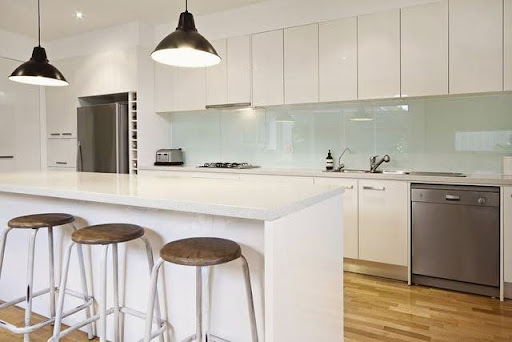
5. Matching splashbacks to kitchen size
Small kitchens benefit from:
- Light tones
- Reflective finishes
- Minimal visual interruption
Large kitchens can handle:
- Darker colours
- Textured or printed designs
- Feature panels behind hobs or sinks
The goal is proportion. A dark splashback in a very small kitchen can feel heavy, while a very pale splashback in a large kitchen may feel underwhelming.
6. Considering hob position and wall space
The position of your hob often determines the focal point. If the hob is centred, the splashback behind it becomes the visual anchor.
For example:
- A mirror panel behind a hob can create depth
- A bold painted glass panel can highlight symmetry
- A printed design can act as artwork
If the hob is placed to one side, balance can be achieved by extending the same material across the full wall.
7. Practical considerations beyond layout
Layout is important, but function matters just as much.
Ask yourself:
- How easy is it to clean?
- Will grease splashes be visible on dark glass?
- Does the material resist heat?
- Does it complement worktops and cabinetry?
Glass splashbacks are popular because they are seamless, heat-resistant, and easy to maintain. The absence of grout lines makes them ideal for busy kitchens.
Final thoughts
Choosing the right kitchen splashback starts with understanding your layout. The shape of your kitchen, the amount of natural light, and the size of the room should guide your choice of colour and finish.
A well-chosen splashback does more than protect your walls. It improves light, enhances proportion, and completes the design of your kitchen.
Frequently Asked Questions
Does the kitchen layout really affect which splashback I should choose?
Yes, your kitchen layout plays a major role in selecting the right splashback. Narrow galley kitchens benefit from light or mirror finishes to create a sense of space, while larger U-shaped or open-plan kitchens can handle darker colours or statement designs. The layout determines how much wall area is visible and how the splashback will influence light and proportion.
Are mirror splashbacks suitable for small kitchens?
Mirror splashbacks are often ideal for small kitchens. They reflect natural and artificial light, making the space feel wider and brighter. In compact layouts, especially galley kitchens, a mirror panel can visually double the depth of the room and reduce the feeling of confinement.
Should I use the same splashback on all walls in an L-shaped or U-shaped kitchen?
In most cases, yes. Using the same splashback material and colour across connected walls creates visual continuity and prevents the kitchen from feeling broken up. However, you can introduce a subtle feature behind the hob while keeping the rest consistent for balance.
What splashback colours work best in open-plan kitchens?
In open-plan kitchens, neutral tones such as white, soft grey, or warm beige work well because they blend with the wider living space. Mirror glass can also enhance light and openness. If you choose a bold colour or printed design, make sure it complements the overall interior rather than dominating it.
How do I make sure my splashback doesn’t overpower the kitchen?
Balance is key. If your cabinets and worktops are already bold or patterned, choose a simple painted glass splashback. If your kitchen design is minimal and neutral, you have more flexibility to introduce colour or texture. Always consider proportion, light levels, and how much wall area will be covered.
